Home » About us » How we engage

How we engage and develop our energy parks (step by step)

We involve people at every stage of our energy projects — from early ideas through to planning, construction and beyond.  On this page, we share how our engagement cycle works, when you can take part, and how your feedback helps shape our plans.

What is Bute Energy’s approach to engagement and consultation?

Our engagement is guided by best practice, including national and local standards in Wales.

We embed the principles as set out by the WCVA on the National Principles for Public Engagement, building on the ethos of the Gunning Four Principles for public consultation.

Some engagement is required by planning rules – according to Welsh Government’s criteria for a Development of National Significance application – or more recently – Infrastructure (Wales) Act 2024.

But we go further. 

The development of projects like ours take place over many years, and it’s normal for things to evolve along the way. Planning guidance can change, external factors can shift, and feedback from communities and stakeholders can highlight new ideas or concerns.  We see this as an opportunity – your feedback helps us adapt, improve, and innovate. That’s why staying involved really matters: your input can shape the project and lead to real change. 

How our engagement works

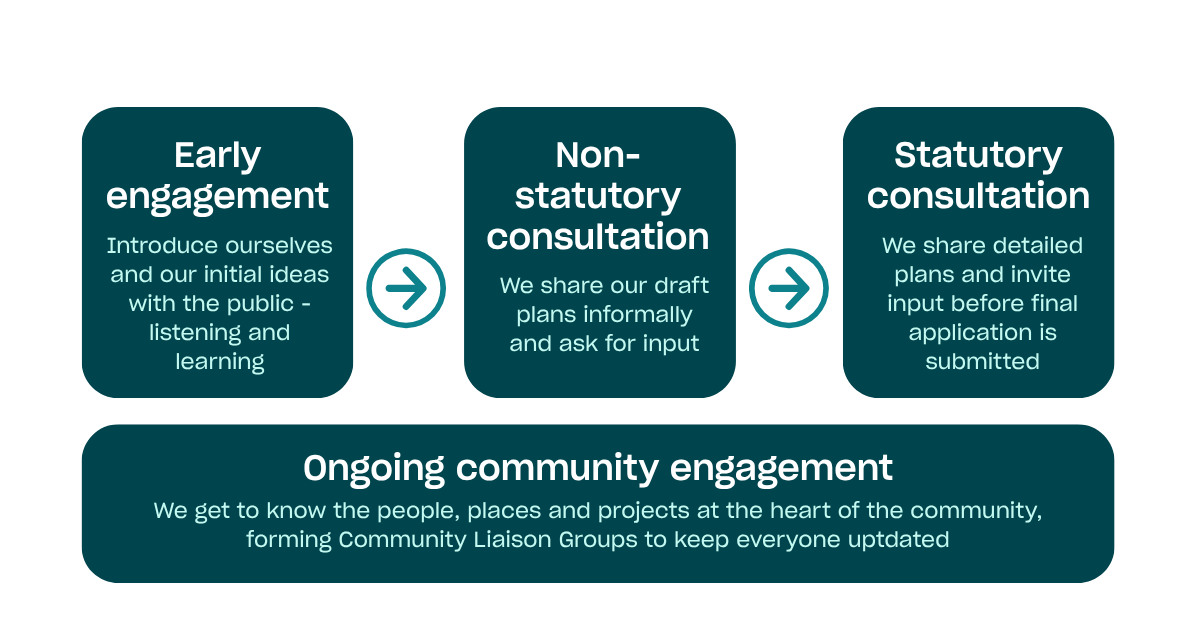
Our projects develop over several years. During that time, we share information, gather feedback, and refine our plans.

There are four main parts –

  1. Ongoing community engagement
  2. Early engagement
  3. Non-statutory consultation
  4. Statutory consultation

Click on the drop-down arrows to learn more about each part:

1. Ongoing community engagement

Our work with communities continues beyond consultation.
We have a dedicated Community Investment team that works throughout the life of our projects to build relationships and deliver local benefits.

This includes:

  • Working with local organisations and community groups

  • Supporting local priorities such as education, skills and cost of living

  • Creating opportunities through suppliers, volunteering and sponsorship

  • Preparing for community benefit funding linked to the project

2. Early engagement

This is the first time we introduce a new energy park and start conversations with local people and stakeholders.

At this stage, we:

  • Share early, high-level information about the project

  • Launch project pages on our website

  • Invite feedback through surveys

  • Attend local events and begin conversations with communities

  • Speak with local authorities and political representatives

  • Identify people interested in joining Community Liaison Groups

Our aim is simple: start the conversation early and give people time to understand the project before formal consultation begins.

At this stage, we don’t yet know:

  • The final site boundary

  • Exact locations of infrastructure (such as substations)

  • Results of environmental surveys

  • Transport and access routes

  • Detailed grid infrastructure plans

  • Construction methods and timelines

3. Non-statutory consultation

This is our first formal stage of engagement.
It is called non-statutory because it is not required by law — but we choose to do it.

At this point, we are carrying out environmental surveys and developing the design of the energy park.

During this stage, we:

  • Share early design proposals

  • Present the site boundary and initial layouts

  • Explain the studies and assessments we are carrying out

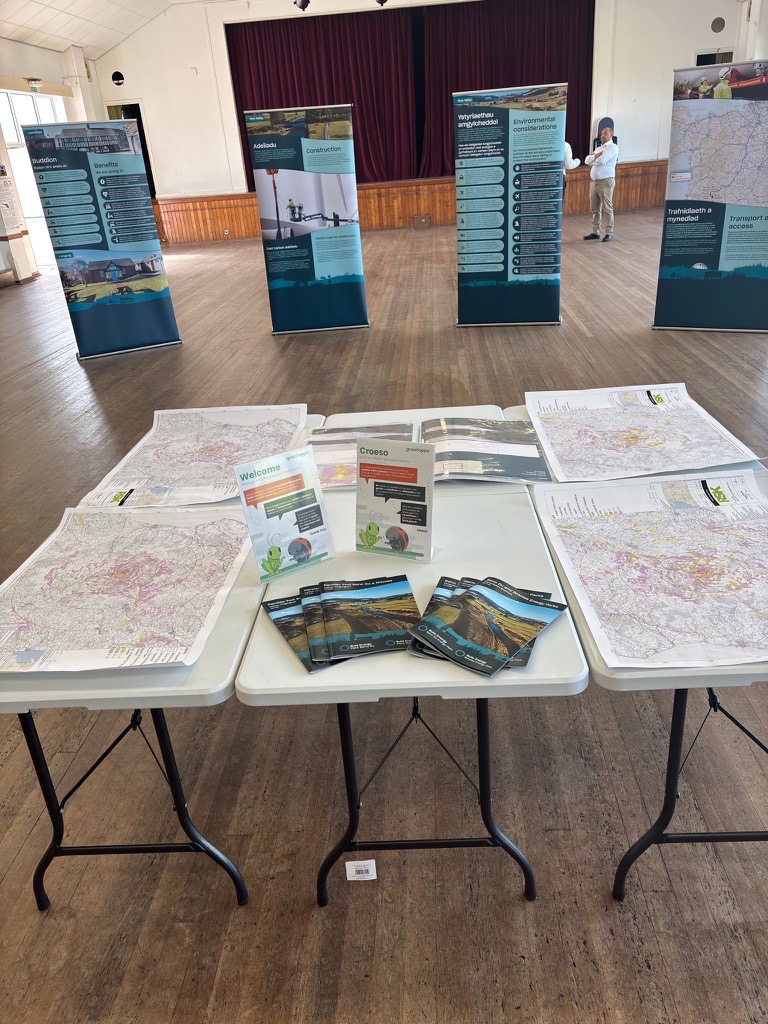
  • Hold consultation events (in person and online)

  • Invite feedback from communities, stakeholders and consultees

This stage usually lasts around 6 weeks.

Your feedback here is important. It helps shape:

  • the design of the project

  • environmental considerations

  • how we respond to local priorities and concerns

At this stage, we don’t yet know:

  • Final infrastructure locations

  • Full environmental impact results

  • Confirmed transport routes

  • Final grid infrastructure details

  • Exact construction plans

4. Statutory consultation

This is the formal, legally required stage of consultation.

By this point, we have completed detailed surveys and prepared a Draft Environmental Statement (ES).


This stage includes:

  • Public notices in local newspapers and near the site

  • Direct notification to consultees (such as local authorities and Natural Resources Wales)

  • Public consultation events (online and in person)

  • Full details of the proposed project

The consultation period lasts at least 42 days.

This is the most detailed stage of engagement.
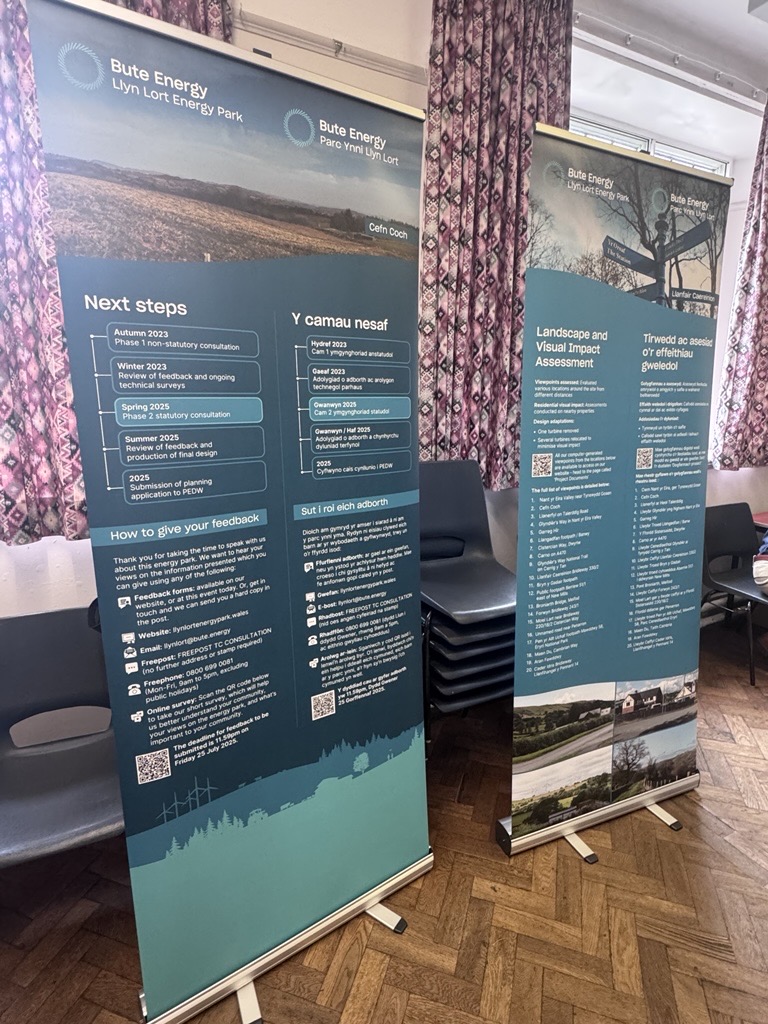
Feedback helps us refine the final design before submitting a planning application.

Community Liaison Groups

We also set up Community Liaison Groups (CLGs) for our projects.

These are regular meetings where local people and organisations can:

  • hear updates

  • ask questions

  • share feedback

  • discuss community priorities

CLGs are:

  • Inclusive – open to a wide range of voices

  • Neutral – not focused on support or opposition

  • Collaborative – built on open, honest discussion

They create a direct link between the project team and the community.

Why your input matters

Energy projects take time to develop, and plans can change along the way.

Your feedback helps us:

  • improve our designs

  • respond to local concerns

  • identify new opportunities

  • deliver better outcomes for communities

Getting involved early can make a real difference.

Get involved

There are several ways you can take part:

Your questions about how we engage on our energy parks

How do I give my feedback about an energy park during a consultation?

There are several ways to contribute to the consultation process: 

  • Feedback form – in person or digitally 
  • Email 
  • Write 
  • Phone 

Can I give feedback about an energy park outside a formal consultation period?

We dedicate significant resources to consultation windows to gain as much information as possible to shape our plans. A window lasts at least 6 weeks and a mixture of in person and online consultation events.  In order to progress with developments we are not required to invite feedback outside of these consultation windows but we try our best to give you and wider stakeholders as much information upfront as possible especially ahead of non-statutory consultation.   

Outside of consultation periods, we aim to directly respond to all incoming queries through the usual methods of email, telephone, post, social media channels.  

We also find that many common themes arise during consultations, therefore, we can keep as many people as possible up to date and provide answers more accessible by updating the website through detailed FAQs. 

Who sees my feedback about an energy park?

If you send us feedback on any of our energy parks during a consultation period – that information is seen by the energy park team members including a number of consultants and agencies we hire to support the project.  Your feedback is used to shape an energy park’s design and ultimately – it will shape our planning application.

Read our Privacy policy for more information on how we handle your data. 

What’s the difference between non-statutory and statutory consultation?

The difference between statutory and non-statutory consultations in planning Wales lies in the legal requirements and the consultees involved: 

Statutory Consultations: These are required by law and involve specific organisations and bodies that must be consulted before a decision is made. They are governed by formal legal requirements, such as the Town and Country Planning (General Development Procedure) Order 1995.  

Non-Statutory Consultations: These are not legally required but are encouraged to involve a broader range of stakeholders who may have an interest in the proposed development. They are identified in national planning policy and can include organisations that are not legally mandated to be consulted.  

In summary, statutory consultations are mandatory and follow strict legal procedures, while non-statutory consultations are voluntary and can include a wider range of consultees.  

What’s the difference between a statutory and non-statutory consultee?

Statutory consultees are organisations and bodies defined by law, such as the Environment Agency and Countryside Council for Wales, who must be consulted on relevant planning applications.  

Non-statutory consultees are organsations identified in national planning policy, which may include bodies that are not legally required to be consulted but are likely to have an interest in a proposed development.  

In summary, statutory consultees are legally obligated to be consulted, while non-statutory consultees are engaged based on planning policy reasons. 

If I speak to a member of staff about an energy park, how does that feedback get recorded?

Our colleagues are always open to discussing our energy parks with you and will try their very best to answer your questions on the spot or commit to coming back to you with a response at a later date.  Ultimately, comments and feedback about energy park as part of a consultation must be made in writing (hand written or email) therefore you’ll be asked and encouraged to complete a feedback form in the first instance – as this is the most efficient way to digest and sort the feedback once the consultation period has closed.  Alternatively, you’re more than welcome to email your feedback to us using the project team email address, usually [insertenergyparkname]@bute.energy  

Head to our energy parks page to find a project near you.

What specific guidelines or legislation do you follow to conduct your consultations?

The key legislation and guidance are within the following publications:
Planning (Wales) Act – This Act introduced the statutory requirement for pre-application consultation for “major development” in Wales and states that developers proposing major developments must show how they have consulted the community as part of the application and produce a Pre‐Application Consultation (PAC) report. 

Town and Country Planning (Development Management Procedure) (Wales) Order 2012 (DMPWO) (and its amendments): Defines what is a ‘major development’ in Wales and the requirements for consultation and publicity (e.g. site notices, documents to be available). 

Pre‑application Community Consultation: Best Practice Guidance for Developers (Welsh Government, December 2021): Helps developers follow the law and good practice on consulting about major developments. 

Local Authority/Planning Authority Guidance: Local planning authorities (LPAs) provide additional guidance, for example on how the PAC report should be submitted, how consultation should be bilingual, what counts as “major” development etc. 

How do you decide where you host your in-person public consultation events?

Where we host our in-person consultations is decided by an energy park’s project team and the decision is determined by several factors: 

  • Location in relation to the proposed energy park: We consider the proximity of the park in relation to nearby towns and areas, either choosing somewhere central or the location closest to the energy park, in consideration with other factors below. 
  • Availability of venues: Our decision is often determined whether venues have availability to take our booking.  We often book out the whole venue to ensure that there’s plenty of room for everyone. 
  • Local recommendation: Local people or groups sometimes recommend venues we should consider to host an event.  
  • Feedback from previous consultations: If we’ve previously held an event in the area (e.g. during non-statutory consultation) then we study the feedback to establish whether the local residents would prefer a different venue next time. 
  • Health and safety: The size of the venue, accessibility and facilities are always considered. 

I don't understand the industry terminology, how can I give feedback when I don't understand the information?

We get it – like other industries – it can be difficult to understand the lingo that we might use every day in our jobs.

We must make sure that you  understand the information we’re sharing with you so that you can contribute to our work.

That’s why we’ve developed a jargon buster of industry terms.

Click here to read it.

If there’s anything else you think we should add to it – let us know by emailing us.